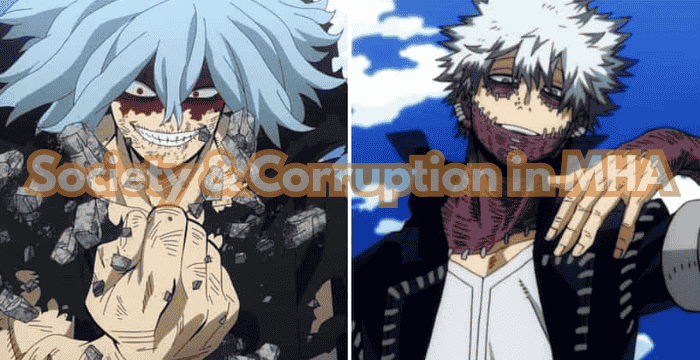
My Hero Academia presents a world where heroes stand as symbols of peace, but beneath the shining surface lies a society filled with cracks — corruption, social pressure, discrimination, and systemic failures. While the series highlights hope and heroism, it also exposes how flawed institutions and misguided ideals can lead to suffering. The rise of villains, the instability of hero society, and the public’s wavering trust reveal a deeper theme: when a society relies too heavily on symbols, it becomes vulnerable to collapse.
This article explores the corruption and societal issues within MHA, examining how they shape both heroes and villains, and what lessons the series delivers.
A Hero System Built on Popularity, Not Justice
One of the largest problems in MHA’s world is that heroes are ranked, judged, and rewarded based on popularity, not pure moral value. This creates a system where image becomes more important than action.
Problems Created
- Heroes prioritize media approval over saving lives.
- Agencies compete for fame instead of cooperation.
- Young heroes are pressured to perform rather than learn.
Characters like Aoyama, Mt. Lady, and even Endeavor show how the hero profession often blurs the line between public service and celebrity culture.
The Hero Commission’s Hidden Corruption
The Hero Public Safety Commission (HPSC) acts as the government’s regulatory backbone for the hero industry — but much of its work takes place in the shadows.
Corrupt Practices
- Manipulating heroes from a young age
- Concealing dangerous information from the public
- Prioritizing order over truth
- Using heroes as political tools
Hawks’ backstory demonstrates this clearly: recruited as a child, trained as a weapon, and controlled emotionally and mentally. Instead of protecting people, the Commission often prioritizes controlling the narrative. Hero vs Villain Morals – Lessons
Society Ignores People Who Don’t Fit the Norm
MHA’s world looks advanced, but social discrimination still exists — especially toward those whose quirks make them look different or difficult to manage. People like Toga, Spinner, and even Tokoyami show that society judges individuals by appearance and quirk type.
How This Leads to Corruption
- People are pushed to the margins of society.
- Villain groups exploit societal neglect.
- Heroes focus on “saving” rather than understanding.
Toga’s inability to fit into a “normal” life, for instance, reveals how rigid expectations can create villains instead of preventing them.
The Media Controls Public Trust
Media plays a major role in shaping public opinion in MHA. Hero society depends on public support, but that support is easily manipulated or shattered.
Issues Created
- Heroes hide failures to protect their reputation.
- Public panic grows when tragic truths emerge.
- Villains weaponize the media against heroes.
After All Might’s retirement, society’s trust collapses almost instantly — not because heroes changed, but because the image of stability vanished.
All Might’s Symbol of Peace — A Double-Edged Sword
All Might’s presence kept villains quiet, but it also masked deeper problems. The world depended too heavily on a single hero, causing people to overlook systemic failures.
Consequences
- Society became passive and overly dependent.
- Other heroes felt overshadowed and inadequate.
- The collapse after his fall was inevitable.
All Might’s retirement exposed the weak foundation of hero society — a foundation built on image, not stability.
Stain’s Philosophy Reveals the System’s Flaws
Stain is one of MHA’s most important villains because his ideology attacks the heart of corruption. He believes:
-
Too many heroes are fake
-
Image matters more than morality
-
Society worships symbols, not values
While Stain is violent and misguided, his influence spreads because people recognize truth in his words. His movement exposes a society that stopped questioning the integrity of its heroes.
Villains Are the Result of Systemic Neglect
Shigaraki, Twice, Toga, and Spinner all suffered in ways that society failed to address. Many villains are not born evil — they are shaped by:
- Trauma
- Rejection
- Lack of support
- Institutional failures
The League of Villains becomes a family for the forgotten, gaining strength from the system’s inability to help those in need. Society’s corruption doesn’t just weaken the hero system — it actively creates villains.
War Arc: The Collapse of Trust
The Paranormal Liberation War reveals the ultimate consequence of corruption — a society that no longer trusts heroes.
Why Trust Breaks
- Heroes hide secrets (like Dabi’s past)
- Institutions fail to protect civilians
- Villains expose hero hypocrisy
After Dabi’s broadcast, the public realizes that even top heroes like Endeavor have dark, hidden pasts. This shakes the foundation of society, proving how fragile hero culture truly is.
Conclusion
My Hero Academia uses its world to explore how corruption, image obsession, and societal neglect can slowly break even the strongest systems. Heroes, villains, and civilians all suffer when truth is hidden and appearances matter more than compassion.
FAQs – Society & Corruption in MHA
Why is hero society considered corrupt in MHA?
- Hero society is corrupt because it prioritizes popularity, image, and rankings over genuine justice. The Hero Commission hides information, manipulates heroes, and maintains control by shaping public perception instead of addressing real issues.
How does the Hero Public Safety Commission influence corruption?
- The HPSC recruits heroes as children, controls their actions, and hides moral failures to protect the hero industry. Their decisions focus on stability over truth, which deepens systemic corruption.
Why do many villains in MHA come from societal neglect?
- Characters like Shigaraki, Toga, and Twice were ignored, abused, or rejected by society. Their trauma went untreated, leading them down destructive paths. MHA highlights how neglect can turn victims into villains.
Does All Might contribute to society’s instability?
- Yes. Although he saved countless lives, his role as the Symbol of Peace caused society to become dependent on a single hero. When he retired, the system collapsed, revealing how fragile the hero world truly was.
Why does the public lose trust in heroes during the War Arc?
- The public loses trust after Dabi exposes Endeavor’s abusive past and reveals how heroes hide their mistakes. This reveals hypocrisy at the top, causing civilians to question whether heroes are truly moral.